Wolfgang Reinle
Head of Project / Process Management
Tenowo GmbH | Germany
100% Surface Inspection Instead of Continuous Sampling – Why We Rely on Basis Weight Monitoring with EasyMeasure.
Conventional technologies for basis weight monitoring in the nonwoven industry, such as beta emitters or X-ray emitters, often cover less than 1% of the total surface area. Beyond providing only spot measurements, they also create significant additional costs due to the need for radiation safety officers and regular safety training for employees. For production lines that require local defect inspection, we rely on Dr. Schenk's EasyMeasure camera inspection system to achieve complete, 100% surface coverage.
With EasyMeasure and EasyInspect from Dr. Schenk.
This enables us to achieve integrated, 100% basis weight monitoring in a single step through built-in defect detection.
Innovative, highly efficient, and transparently documented for absolute process reliability!
The Solution: EasyMeasure by Dr. Schenk
Expanding our existing surface inspection system with camera-based grammage monitoring using visible light has made our inline quality control highly cost-effective. Since the defect inspection system, was able to take this task as well, no additional capital-intensive hardware was required. Unlike conventional systems, this technology offers:
- Comprehensive monitoring: We achieve 100% surface coverage.
- Dual Monitoring: In addition to basis weight, the
- Formation (cloudiness/homogeneity) can be continuously monitored as an option.
- Maintenance-Free: Since the system operates without additional hardware or traversing mechanisms, mechanical sources of wear—and thus maintenance tasks—are completely eliminated.
- Documentation of measurement data and graphical representation.
Impressive Technology & Precision
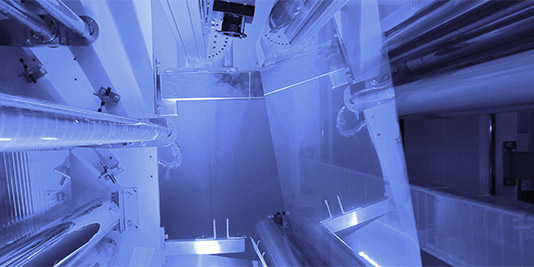
The durability of the hardware is particularly noteworthy. Thanks to the innovative water cooling system of Dr. Schenk LEDs, the temperature of the modules remains constant at approximately 40°C, whereas air-cooled lighting units can reach temperatures of up to 90°C—resulting in fluctuating, degrading light intensity. The water cooling system ensures consistently accurate measurement results without drift. This is the fundamental prerequisite for reliable basis weight monitoring.
The Solution
The optional calibration was incredibly simple and took just four steps—from taking the transmission images to entering the parameters (correlation between lab measurements and gray values) into the system. Today, we can immediately see in the live view (VIZ) whether our production is within the “OK” range or if there are any deviations (NG).
 International
 Deutsch
 US
US 中文
中文 日本語
日本語 Surface Inspection – Embedded in AI-Ecosystem The state-of-the art surface inspection solution Dr. Schenk Inspection System is embedded into a unique AI-Ecosystem, in which all proprietary components are purpose-built to deliver seamless performance. From your first intuitive image labeling with the AI Workbench to the fully automated robust defect detection and classification.
 Ultra-fast, precise & reliable optical plastic inspection and measuring solutions for all kinds of base and converted plastic materials.
 Local defect detection for many different nonwoven technologies (spundbond, spunlaced, meltblown, composite, wetlaid, airlaid, carded, needlepunched, thermal bond) and continuous 100% surface monitoring of key properties, e.g. homogeneity, for a low variation coefficient of the production.
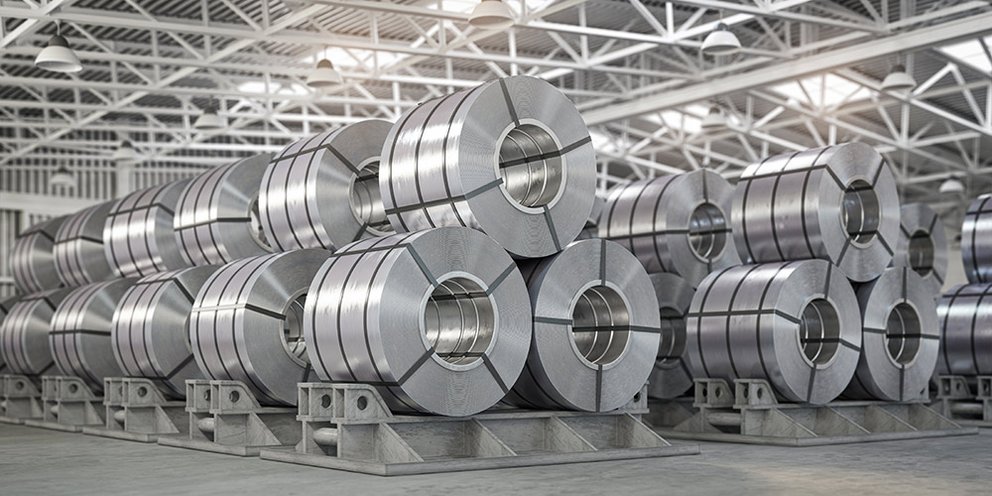 Fast, reliable, and efficient optimization of production and product quality for metals with EasyInspect & EasyMeasure.
 Reliable defect detection, monitoring of presence, position and properties of security features and geometry measurement of paper sheets.
 Defect detection and large area property monitoring solutions for all kinds of flat glass.
 Display and touch panel inspection for reliable inline quality control of all kinds of manufacturing technologies.
 Inspection solutions for nearly every step in the production of lithium-ion batteries, fuel cells and solar cells.
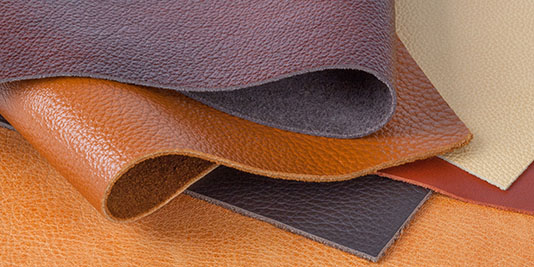 Complete optical inspection solutions for structured materials: detection of natural marks on cow hides and wood as well as defect detection on the surfaces of synthetic leather, in carbon fibres, textiles and fabrics.
 The modularity and flexibility of GlassInspect and EasyInspect is also applicable to other market segments and applications in specialty markets.
 Dr. Schenk customers benefit from more than 35 years of experience. You, too, can rely on us when you implement a new system or switch from another system to an automatic in-line inspection solution from Dr. Schenk.
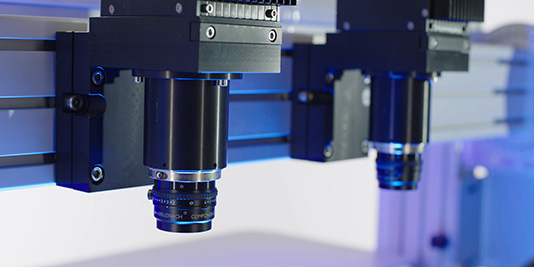 Dr. Schenk offers extensive from-lab-to-fab knowledge for customized solutions. Customers benefit from our expertise in the translation of lab applications to large scale productions.
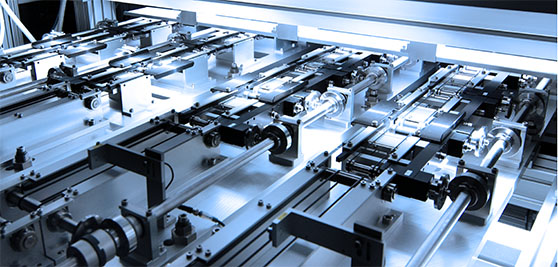 Integrated handling and inspection solutions for customers who want material handling & inspection from a single source - without loss of time or money for coordinating different providers.